
VLF detectors offer greater discrimination and higher sensitivity towards smaller, shallower targets.


VLF Gold Detectors

 ENQUIRER17999
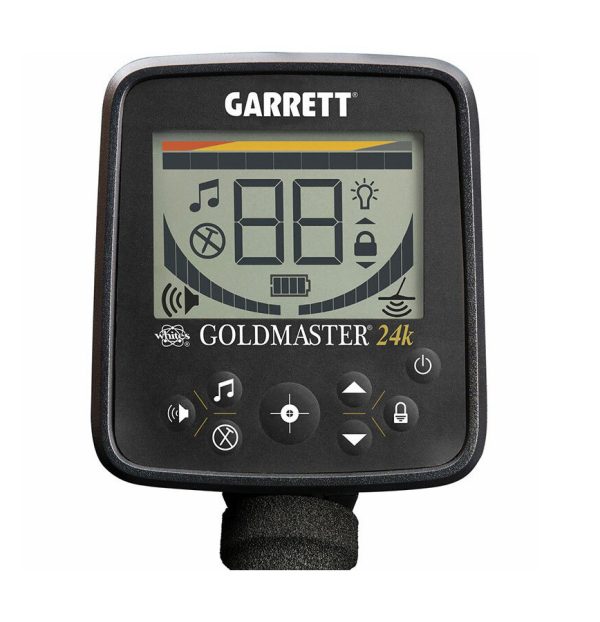
Goldmaster 24k Metal Detector – Take your prospecting to new depths.
- Super Sensitive Gold Detector.
- 48 kHz power: find more gold. Automatic Ground Balance (XGB Technology).
- Iron and Hot Rock Elimination.
- Rainproof detector with waterproof searchcoil.
Turn on and begin searching!
 SHIPS WITHIN 2-5 DAYSR24500
The GOLD MONSTER 1000 turns beginners into experts with fully automatic operation in an easy-to-use, high performance detector. This version comes with the 5″ search coil.
 SHIPS WITHIN 2-5 DAYSR27500
The GOLD MONSTER 1000 turns beginners into experts with fully automatic operation in an easy-to-use, high performance detector. This version comes with 2 coils included.
 ENQUIRER0
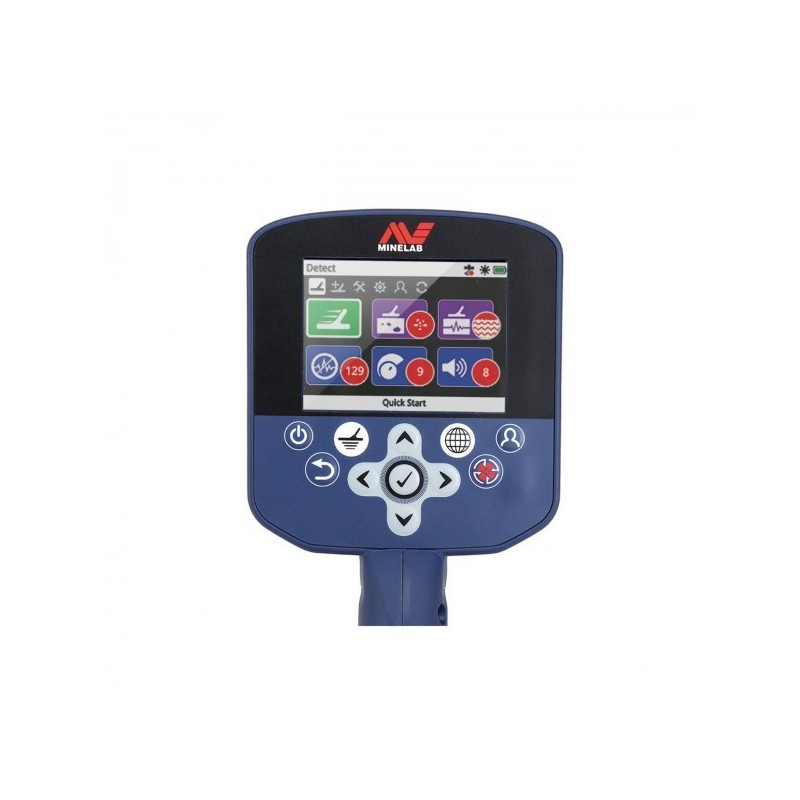
GOLD MONSTER 2000™ tracks ultra-fine gold with sharper precision in mineralised ground using Minelab’s Multi-Au™ technology, which combines VLF sensitivity and a Pulse Induction soil handling engine.
Echo Wave™ Audio makes it easier to identify valuable targets by distinguishing weak gold signals from hot rocks, iron trash and interference.
A real-time Gold Chance Indicator provides visual feedback on the likelihood of detecting gold versus junk, while the carbon-fibre telescopic shaft delivers portability without sacrificing durability.
 ENQUIRER29999
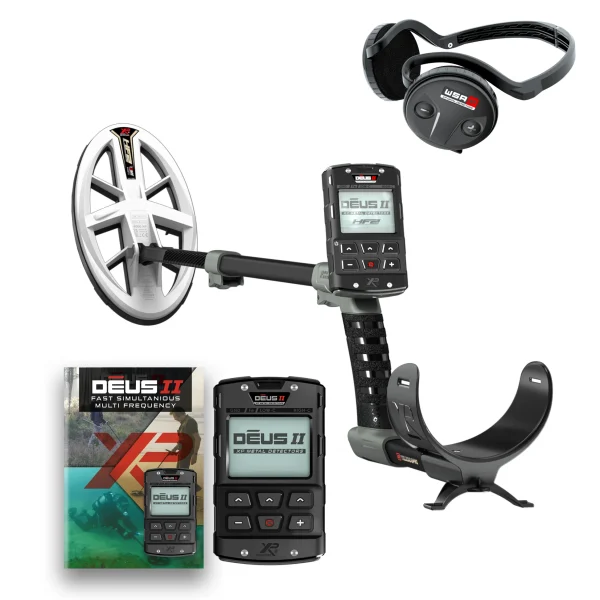
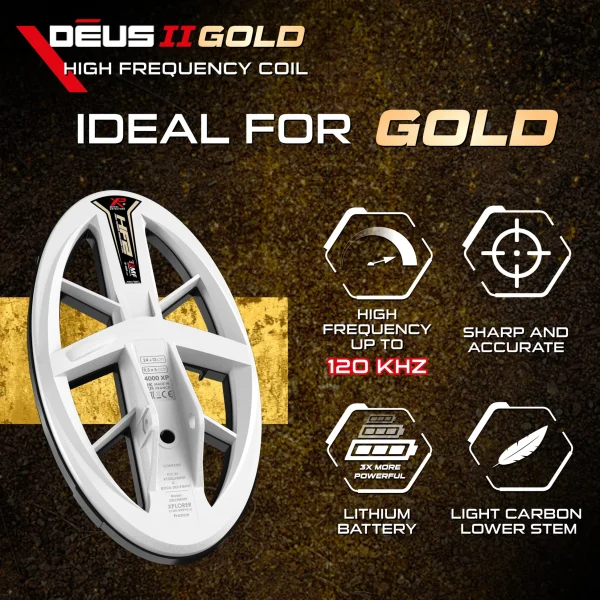
The XP Deus II Gold is built for serious detectorists who want lightweight wireless performance, extreme sensitivity, and excellent target separation in difficult ground conditions.
With XP’s Fast Multi-Frequency technology, HF2 high-frequency coil, and WSA II Stereo Wireless Headphones, this setup is designed for gold, jewelry, relics, mineralized soil, iron-heavy sites, wet ground, and more.




Pulse Induction Gold Detectors
Pulse Induction (PI) detectors offer greater depth performance and superior stability in highly mineralised soils.
 SHIPS IMMEDIATELYR49999
Garrett’s most powerful pulse induction gold prospecting detector!
- Includes 7″x11″ Mono coil, coil cover, charging cable, and carry bag.
 ENQUIRER59999
ATX Basic packages include:
Garrett ATX with 11″x 13″ DD closed searchcoil
- Garrett MS-2 Headphones (waterproof headphones sold separately)
- 11″ x 13″ closed coil cover
- Garrett Detector Sling
- Battery charger
- AA alkaline and rechargeable batteries
- Soft storage/travel case
- Owners Manual
 ENQUIRER69999
Garrett ATX with 20″ (50 cm) Mono Deepseeker and 11″x 13″ DD closed search coils
- 20″ (50cm) Deepseeker mono coil
- 11″ x 13″ DD closed coil
- Garrett MS-2 Headphones (waterproof headphones sold separately)
- Military-grade Garrett hard case
- Garrett Detector Sling
- AA alkaline and rechargeable batteries and charger
- Travel case
 ENQUIRER108000
All Terrain Gold Detecting
The SDC 2300 is a compact high performance mid-range gold detector perfect for chasing down elusive sub-gram nuggets on land & underwater
 ENQUIRER239000
The Future of Gold Detection
With extreme depth and maximum sensitivity on all gold, the innovative GPZ 7000 gold detector takes you to the NEXT LEVEL of gold detection.
 ENQUIRER179000
All gold. All soils. All the time. Find all gold, big and small, with this incredibly powerful gold detector. With advanced GeoSense-PI™ technology and two included coil options, you can detect gold more clearly with less interference.



- Soil conditions matter – South African and African soil can be highly mineralised. Pulse induction (PI) metal detectors work better and more stable in highly mineralised soil than VLF detectors
- Frequency matters – Higher frequency improves detection on small gold sensitivity
- Detection type – VLF for better discrimination (easier to identify iron vs good targets), Pulse Induction for deeper ground penetration
- Terrain matters – Consider waterproof detectors for when detecting in rivers or water
- Skill level – Beginners should prioritise ease of use over complexity
Gold detecting in South Africa requires metal detectors that can handle mineral-rich ground conditions. Choosing the right detector depends on your experience level, terrain, and target type.
- Beginners should focus on simple, stable detectors with easy setup
- Advanced users benefit from detectors with higher sensitivity and adjustable ground balance
- Prospecting in highly mineralised areas often requires pulse induction detectors in order to penetrate deeper into the mineralised soil compared to cheaper VLF detectors which may struggle in those same conditions
What is the best gold detector for beginners in South Africa?
Beginner-friendly detectors are those that are easy to use, stable in mineralised soil, and do not require complex setup.
Can gold detectors be used in South African soil conditions?
Yes, but South African soil is often highly mineralised, so pulse induction (PI) detectors are preferred, alternatively VLF detectors with good ground balance features generally perform more stable.
How deep can a gold detector detect gold?
Depth will always vary depending on the model, coil size, soil and environmental conditions, shape and gold size. Small nuggets are typically detected at shallow depths, while larger targets can be detected deeper. The bigger the coil size the deeper the detection on larger sized gold, while smaller coils are preferred for finding the smaller, shallower gold.
What type of detector is best for gold prospecting?
Pulse Induction detectors are generally preferred for highly mineralised ground and deeper searching, while VLF detectors are better for general use.
Are expensive gold detectors worth it?
Higher-end detectors typically offer better sensitivity, stability, and depth, which can make a significant difference in difficult ground conditions.
Do I need experience to start gold detecting?
No, but beginners should start with simpler machines before moving into advanced prospecting detectors.
What is the difference between a gold detector and a normal metal detector?
Gold detectors are tuned to detect smaller and lower conductivity targets like gold, whereas general metal detectors are designed for a wider range of metals. Gold detectors will still however detect all types of metals, not just gold!
Do I need a permit for gold prospecting in South Africa?
In South Africa, prospecting or mining for gold requires an official permit or right from the Department of Mineral Resources and Energy.
However, metal detecting recreationally at public parks and beaches does not require any permits.